
Exercise and equipment
Resistance bands for beginners: a practical introduction
New to resistance bands? This introduction explains how they work, why movement control matters and what to consider before you begin. Bands are compact and easy to take with you, whether you train at home, outdoors or in a gym.
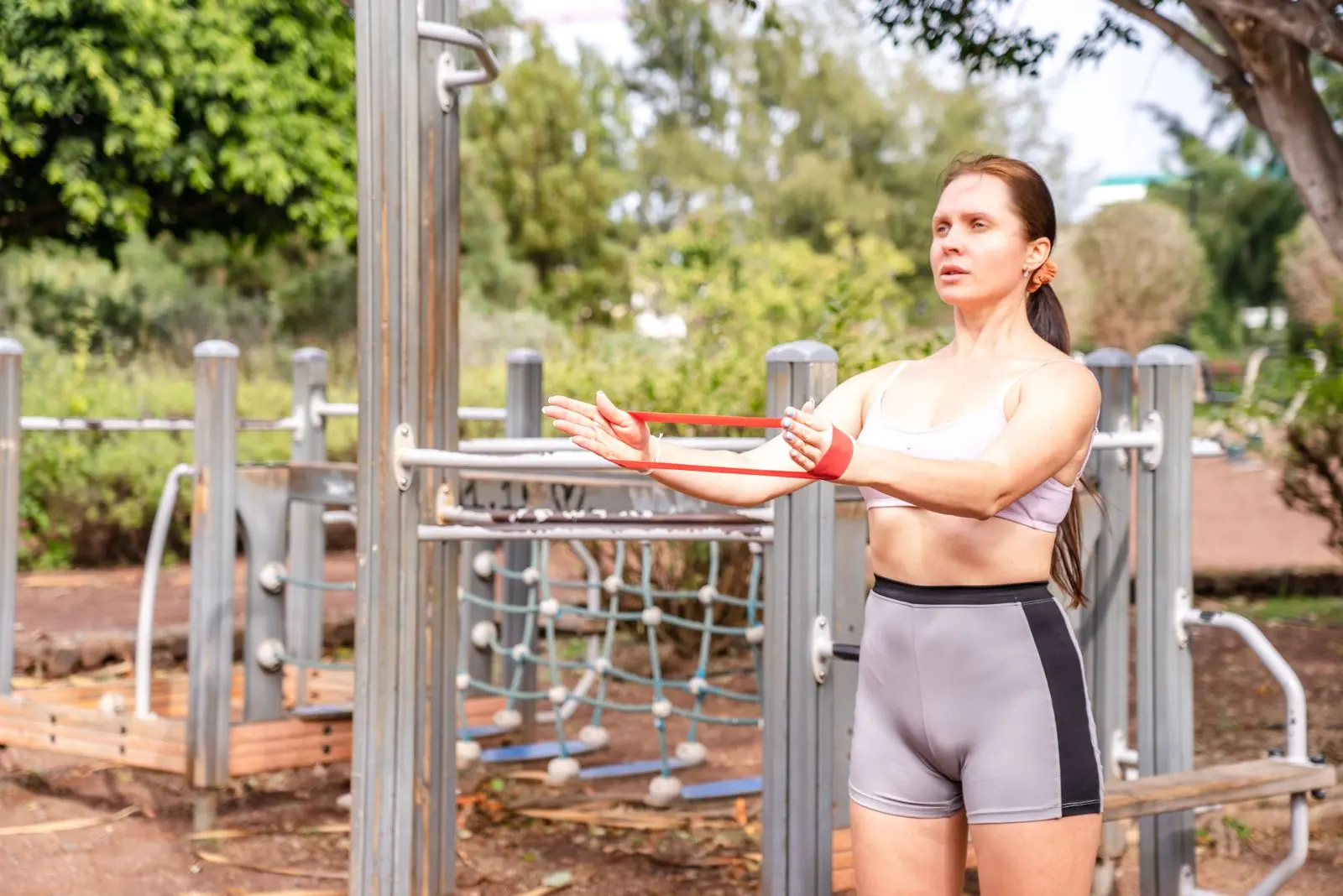
Resistance bands earn their place in a training kit for very practical reasons. They are relatively inexpensive, take up very little room and can be used for a wide range of movements. A spare room, hotel room, garden or quiet corner can all become somewhere to exercise.
Convenience is only part of their value. A band creates tension while also asking you to control its direction. That means the muscles around a joint—and the rest of your body—often have to help you stay steady as you move.
Why consider resistance bands?
Bands make strength work easier to fit around real life. You can use them alone, combine them with bodyweight exercises or add them to a session that also uses free weights and gym equipment.
A small set needs very little space at home.
They can travel with you when your usual equipment cannot.
Resistance changes with the band, your grip and your position.
A movement can be made simpler or more demanding as needed.
The work you may not notice
When people think about exercise, they often picture the larger muscles doing the obvious work: the legs in a squat, the arms in a curl or the abdominal muscles in a plank. Less visible are the many muscles helping to control position and keep the movement steady.
A plank makes this easy to feel. No single muscle holds the body in a straight line; several areas work together to stop the hips, shoulders or feet drifting out of position. Band exercises can create a similar demand because the band will not guide your body along a fixed track.
A band curl in practice
Consider a biceps curl. On a seated machine, pads and the machine’s path help support your position so you can concentrate on the target muscles. With a standing band curl, your body has to create that stable starting point.
The equipment supports the position
Your arms follow a set path while the pads help keep the body still.
You create the stable base
Your feet anchor the band while your legs, trunk and shoulders help control the pull.
Neither version is automatically better. They place different demands on you and can each have a useful role. Understanding that difference makes it easier to choose an exercise for a reason rather than simply copying a routine.
Using resistance bands at home and away
Once you understand a few basic movements, bands can help you keep training when your surroundings change. At home, they offer more options without filling a room with equipment. When travelling, they can help you maintain a familiar routine after long periods of sitting. Outdoors, they can be combined with walking or bodyweight work.
This flexibility is one reason I teach clients the principles behind an exercise. My goal is for you to understand what a movement is doing, how it should feel and how to adapt it when a particular machine or weight is unavailable.
Are resistance bands easy?
A band workout can be gentle or demanding. The challenge changes with the band’s resistance, how much it is stretched, your body position, the range of movement, the number of repetitions and the speed at which you work.
More tension is not always more useful. A lighter band used with good control may teach you more than a heavier band that pulls you out of position. The right level lets you feel the intended movement while staying in control from start to finish.
Getting started with resistance bands
- Choose a lighter resistance while learning a new movement.
- Check the band for damage and make sure any anchor point is secure.
- Keep the movement controlled as the band stretches and returns.
- Use enough clear space that the band cannot catch on nearby objects.
- Ask for professional guidance if you are unsure what suits your body or you are returning after injury.
This article provides general information, not a personalised exercise programme. Stop if a movement causes pain or makes you feel unwell and seek appropriate advice before continuing.
Keep moving.
Learn by doing
Build skills you can use wherever you train.
Have a question? Send Jacqui a message. It is just a conversation, with no obligation to book.
Talk to Jacqui